


For as long as I’ve been watching this league, the plan for a bad team has been simple: if you’re going to lose, lose a lot. Bottom out, grab the best lottery odds and hope the ping-pong balls love you.
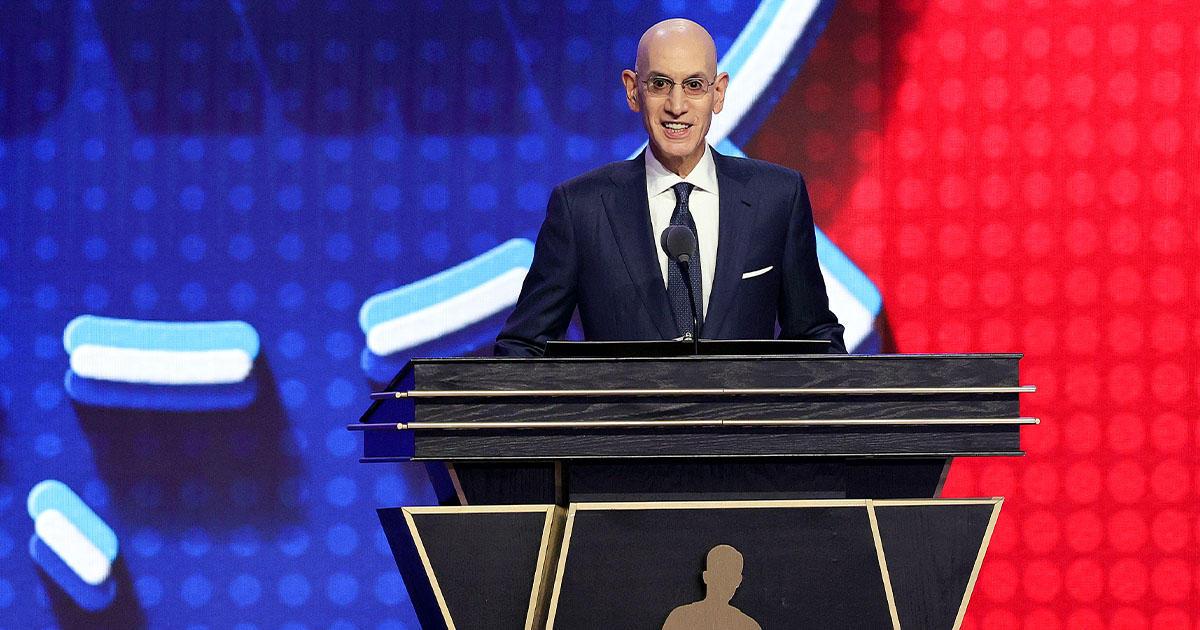
That plan doesn’t work anymore. The 2026-27 season tips off Tuesday, and it’s the first season that feeds into the NBA’s new “3-2-1 Lottery.” The Board of Governors approved it 29-1 back in May, with Memphis the only team voting no, and it changes the math on losing more than any lottery tweak I can remember.
Last season is the reason it exists. Five teams (Washington, Utah, Indiana, Memphis and Brooklyn) won fewer than 18% of their games after the All-Star break, the Jazz got fined $500,000 for sitting two of their best players in fourth quarters, and Adam Silver finally had enough. “We are going to fix it,” he said in March. “Full stop.”

How the 3-2-1 lottery works
The lottery grows from 14 teams to 16, and every team in it gets three, two or one ball in the drawing:
- Three balls: the teams with the fourth- through 10th-worst records. That’s an 8.1% shot at No. 1 each.
- Two balls: the three worst teams in the league, plus the No. 9 and No. 10 play-in seeds in each conference. That’s 5.4% each.
- One ball: the two teams that lose the 7-vs-8 play-in game. That’s 2.7% each.
The drawing sets all 16 picks, not just the top four. The three worst teams can’t fall below No. 12, but everyone else can slide all the way to 16.
Being the worst team is now a sucker’s bet
Under the old system, the three worst teams each had a 14% shot at No. 1. Washington went 17-65 last season, cashed in that 14% and walked away with AJ Dybantsa.
Do that next season and you get punished for it. The bottom three are now in what the league calls “draft relegation.” They lose a ball and end up with the same odds as a team that made the play-in. The best odds in the league now belong to the team with the fourth-worst record, not the worst.
So the goal for a rebuilding team isn’t to be the worst anymore. It’s to be bad enough to stay out of the play-in, but good enough to stay out of the bottom three. The floor at No. 12 softens the blow a little, but nobody is tanking for the 12th pick.

No more back-to-back jackpots
There are new guardrails too. A team’s own pick can’t land at No. 1 in back-to-back drafts, and it can’t land in the top five in three straight drafts. That applies even if the pick has been traded.
That kicks in right away. Washington’s own 2027 pick can’t be No. 1, no matter how bad the Wizards are. Utah picked in the top five in each of the last two drafts, so its own pick can’t crack the top five next June. Memphis owns a piece of that Utah pick from the Jaren Jackson Jr. trade, which tells you why the Grizzlies were the lone no vote.
Teams also can’t put top-12 through top-15 protections on newly traded picks anymore, so front offices have fewer ways to hedge their deals.
The play-in just got weird
This is the strangest part. The No. 9 and 10 seeds have the exact same odds at No. 1 as the worst team in the league, and a 9th seed gets twice as many balls as the team that loses the 7-vs-8 game.
One executive told Front Office Sports, “That aspect doesn’t make sense to me,” and I’m with him. If you’re a fringe team in March with no real shot at a playoff run, why fight your way up from 9th to 8th? Staying put doubles your lottery odds. The league is going to have to watch the play-in race as closely as it watched the bottom of the standings last year.
Does it actually stop tanking?
Sam Presti thinks so. At his preseason press conference, the Thunder boss said “the bottom of the league is going to be significantly stronger” and that he expects “net ratings and records that are more similar to the ’80s.”
Silver also has new teeth. The league can now cut a team’s lottery odds, move its draft position or hand out big fines if it decides that team is tanking.
I’m not fully sold yet. This season might look cleaner no matter what, because about 11 first-round picks in the 2027 draft were already set to change hands, so plenty of bad teams have nothing to tank for. The real test comes in 2028 and 2029, when more teams own their picks. And the rules only run through 2029 before the owners have to vote again.
So who wins?
The winners are the teams that are bad but not hopeless, the fourth- to 10th-worst group, plus teams like Brooklyn, Charlotte, Houston and Memphis that hold extra first-round picks over the next few drafts. The losers are the teams that planned to bottom out for one more year.
Honestly? I like it. Watching five teams lose on purpose after the All-Star break was ugly, and anything that makes March basketball worth watching again is a win. But tanking isn’t dead. It just moved to the middle of the standings, and front offices are damn good at finding loopholes.
Do you think the 3-2-1 lottery fixes tanking, or did the NBA just move the problem?