
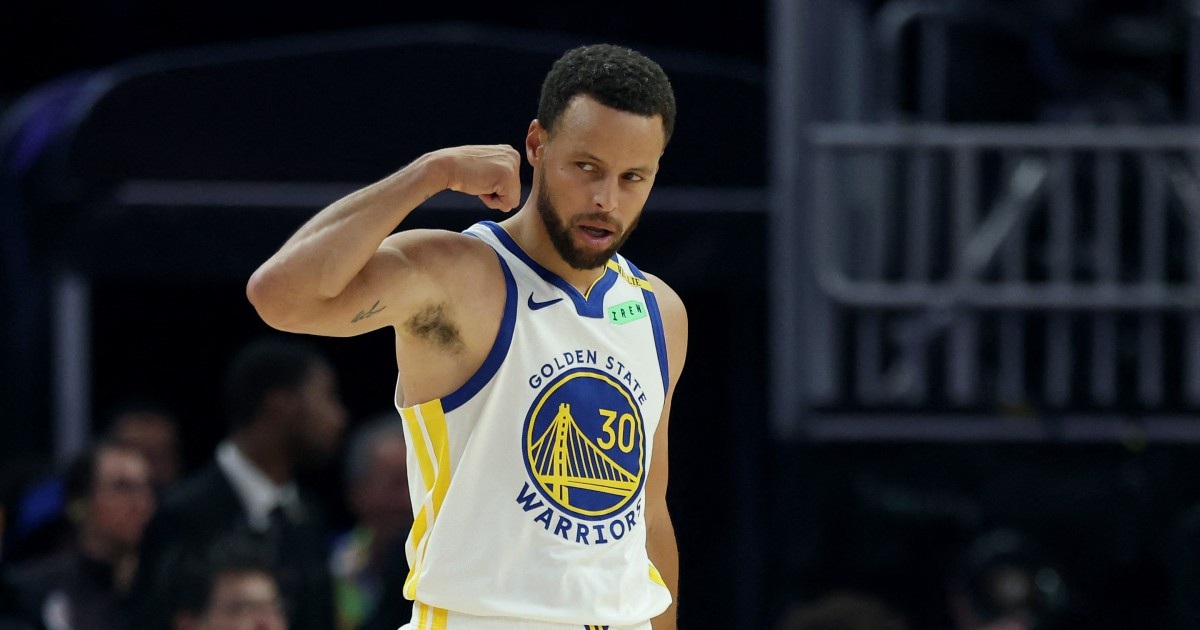


The Golden State Warriors made one thing official last month: Stephen Curry is going to finish his career in the Bay. The two-time MVP agreed to a two-year, $116 million extension that runs through the 2028-29 season, which would be his 20th, all with one franchise.
If he plays it out, he’ll join Dirk Nowitzki, Kobe Bryant and Udonis Haslem as the only players to spend 20 seasons with one team. That’s the easy part.
What are Curry’s last seasons actually for?
The hard part is figuring out what those last three seasons are actually for. Last season was the first time in a long time that the Warriors looked ordinary, finishing 37-45 and 10th in the West before a play-in exit in Phoenix.
Curry was still Curry when he played, averaging 26.6 points and 4.4 threes per game at 38 years old. However, a nagging knee injury limited him to just 43 games, and the Warriors simply didn’t have enough when he sat.
Then there’s Jimmy Butler, who tore his ACL against Miami in January. Nobody can say with any confidence when he’ll be back or what he’ll look like when he is.
Where do the Warriors go from here?
The offseason didn’t really answer that question, at least not in the way Warriors fans were hoping. Golden State took big swings at Giannis Antetokounmpo and LeBron James, missed on both and then mostly ran it back.
Draymond Green returned on a one-year deal, Kristaps Porzingis got an extension, Al Horford, De’Anthony Melton and Gary Payton II all came back and Georges Niang was the biggest outside addition. It’s a bit like a band going back on tour with the same setlist because the label wouldn’t pay for a new album. The crowd still shows up for the headliner, but everybody knows which songs they bought tickets for.
Is there a bridge to the post-Curry era?
The one genuinely new piece is Yaxel Lendeborg, and he might be the most interesting thing about this team right now. The No. 11 pick out of Michigan finished with 17 points and nine rebounds while shooting 7 of 11 from the field in the 124-98 preseason blowout of the Lakers.
Sure, the Lakers were missing Luka Doncic and Austin Reaves that night. Still, rookies don’t usually look that comfortable that fast, especially on a team built around guys in their mid-30s.
There’s also Brandin Podziemski, who just signed a five-year, $110 million extension on Saturday after being the only Warrior to play all 82 games last season. He and Lendeborg are the closest thing Golden State has to a bridge into the post-Curry era, and the Warriors have to decide how much of this season they’re willing to hand them.
The preseason hasn’t settled anything either. The Warriors split their first four exhibition games, and for every fun night like that 81-point first half against the Lakers, there was a loss to the Clippers or the Blazers.
Rebuild or go for it?
Here’s where I have to be honest. Maybe I’m being sentimental, and maybe the smart, cold-blooded move is to treat this as a transition year, protect the picks and let the kids play through their mistakes.
However, I don’t think that’s what the Warriors should do. A 38-year-old Curry who can still drop 26 a night isn’t a reason to rebuild, he’s a reason to go for it one more time.
That doesn’t mean mortgaging the future for a 40-win team. It means using the cap flexibility they lined up this summer to land a real second creator before the trade deadline, someone who can run the offense in the minutes Curry spends on the bench.
If Butler looks like himself by February, great, that solves a lot of it. If he doesn’t, the Warriors can’t afford to spend another spring hoping things work out.
Because let’s be real, what’s the alternative? Letting Curry play out the end of his career on a team fighting for the 10th seed would be a waste of the greatest shooter who ever lived, and the fans who watched him hang four banners deserve a hell of a lot better than that.
Does the new lottery even reward tanking anymore?
This is where the NBA’s new draft lottery comes in, and it makes the case for going for it even stronger. Starting with this season, the league is using what it calls the “3-2-1 lottery,” which the Board of Governors passed 29-1 in May, with Memphis as the only no vote.
The lottery now has 16 teams instead of 14, and each one gets three, two or one lottery balls. Every ball is worth about a 2.7% chance at the No. 1 pick.
Here’s how they’re handed out. The teams that miss both the playoffs and the play-in get three balls each, or an 8.1% shot at the top pick. The four teams that enter the play-in as the No. 9 and No. 10 seeds get two balls, or 5.4%, and the two teams that lose the 7-versus-8 play-in game get one ball, or 2.7%.
The twist is what the league is calling “draft relegation.” The three worst teams in the NBA lose a ball and drop to 5.4%, the same odds as a play-in team, and they can still fall as low as 12th. On top of that, nobody can pick first in back-to-back drafts or land a top-five pick three years in a row, and the league gave itself more power to punish teams it catches tanking.
Let’s look at that again. Finishing dead last now gives you the exact same shot at the No. 1 pick as sneaking into the play-in as a 10th seed, which is where the Warriors finished last season.
For a team like Golden State, that settles it. Curry and Butler alone are making about $121 million this season, nearly three-quarters of the salary cap, and you don’t pay that kind of money to finish in the bottom three. Under the new rules, you wouldn’t even get rewarded for it.
If anything, the math pushes the Warriors toward the play-in. If they end up as the No. 9 or No. 10 seed, they get the same two balls as the worst teams in the league, plus a real chance to play their way into the playoffs. Why would anyone tank when the floor and the ceiling both point in the same direction?
Honestly, I love this change. It turns the middle of the West into a race again, and for a franchise paying Steph through 2028-29, chasing wins is now the only plan that makes any sense.
Can the defense hold up?
The defense might be the bigger worry, though, because the guy who anchored it for a decade is slowing down. ESPN’s Dean Oliver pointed out that Golden State actually defended better with Draymond off the floor last season, something that had only happened once before in his career. If the engine of your defense is running out of gas, who holds things together on that end?
Steve Kerr is back on a new deal, so the coaching continuity is there. The talent question is the one still hanging over this franchise, and it won’t go away just because Curry’s contract got done.
For now, the Warriors get to open the season against Luka and the Lakers at Crypto.com Arena on October 21. Let’s see if the front office gives Steph a team that’s still playing meaningful games in May, because he’s more than earned one.