



In a shock move, the Boston Celtics shook up their franchise earlier this month.
Boston traded Jaylen Brown to the Philadelphia 76ers for Paul George, two first-round picks, and two second-round picks, ending Brown’s 10-season run with the only team that he had ever played for in the NBA.
It is a stunning move in many ways–Brown was the 2024 NBA Finals MVP and is coming off the best statistical season of his career. With Jayson Tatum sidelined for most of the year while recovering from an Achilles tear, Brown carried a heavier burden and averaged career highs of 28.7 points, 6.9 rebounds, and 5.1 assists.
Brown leaves Boston as a five-time All-Star and as one half of one of the league’s most successful tandems in history. Alongside Tatum, he helped deliver the Celtics the 2024 NBA championship and won more combined regular-season and playoff games than any other player in the league during his 10 seasons with the Celtics.
Trading him to division rival Philadelphia makes the move even more dramatic.
The 76ers upset the Celtics in the first round of the 2026 NBA Playoffs, the latest chapter of a rivalry that has now produced a record 23 postseason matchups. Brown joins the team that ended Boston’s run last season, while the Celtics will try to move forward with a roster built around Tatum.
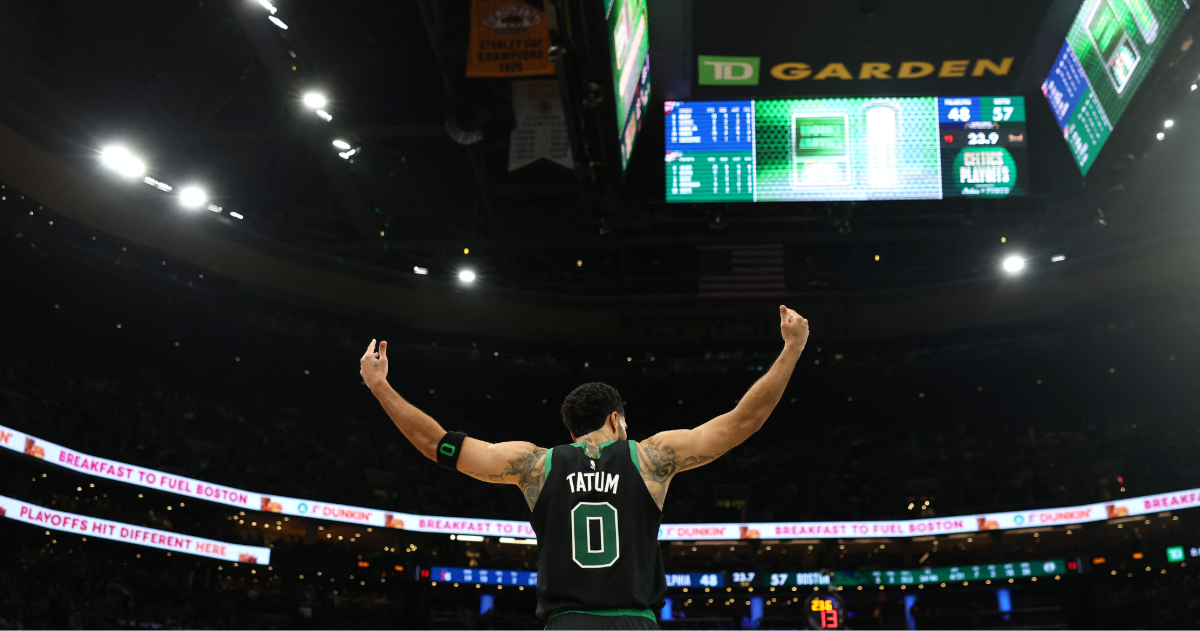
With Brown gone, Tatum is now the unquestioned top option in Boston more than ever. The organization has chosen to surround him with more shooting, ball movement, and complementary pieces, while moving away from a partnership that, successful as it was, was unfavored analytically and may have finally reached its limit.
The Celtics’ most notable return in terms of name value is the nine-time All-Star George. He is already 36 years old, so Boston should not expect him to be the same player that he was in his prime, yet he still averaged 17.3 points last season with Philadelphia and shot 39.2 percent from three on 6.9 attempts per game across 37 games. If George can give Boston reliable perimeter shooting and contribute points in the high teens, that should be enough.
The Celtics also have a strong guard rotation around Tatum. Derrick White and Payton Pritchard remain in place, while veteran Mike Conley adds experience and steadiness after signing a one-year, $3.9 million deal for his 20th NBA season.
On the wing, Tatum will line up next to impactful shooters in George and Sam Hauser, along with Hugo Gonzalez, Baylor Scheierman, and Jordan Walsh, who all had moments while Tatum was out. Boston also strengthened its frontcourt by signing center Mitchell Robinson to a three-year, $47.4 million deal. Robinson, fresh off a championship with the New York Knicks, should give the Celtics an important interior presence alongside Neemias Queta and Luka Garza.
The question for the upcoming season is whether this new version of Boston can still reach the standard the franchise has set for itself in recent years and in its 80-year history. The Celtics have won at least 50 games in five straight seasons, and that kind of consistency may be difficult to maintain after trading away a player as accomplished as Brown.
Boston may have given up a franchise pillar, but it also gained flexibility, draft capital, and now have a roster that better aligns with how their front office wants them to play.
The Tatum-Brown era won a championship which means it will always be remembered fondly in Boston. Now, what remains to be seen is whether this new Tatum-led era can replicate this success and further build on his legacy with this storied franchise.