
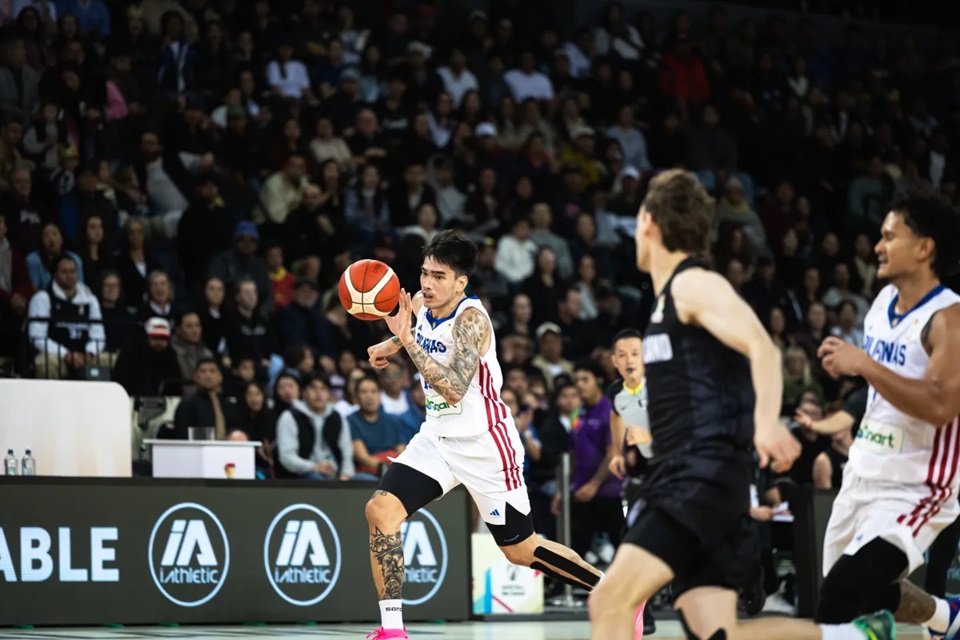



Gilas Pilipinas fell short against New Zealand, but this was one of those losses that will be remembered for the right reasons.
Despite a 106–102 double-overtime defeat to the Tall Blacks—a team ranked 12 places ahead of them in the latest FIBA rankings—the Philippines saw its young core rise to the occasion. On a night when import Justin Brownlee was held to just five points, Gilas’ next generation rewarded head coach Tim Cone’s faith and offered fans hope of a brighter future.
Brownlee, Gilas’ primary offensive weapon, was held to just five points on only three field-goal attempts. He did not even attempt a shot until the second quarter and did not make one until the first overtime. With Brownlee unusually quiet, the Philippines needed someone else to shoulder the load—and its younger players, all still in their mid-20s, answered the call.
Juan Gomez De Liano delivered what was indisputably the best game of his Gilas career, finishing with 23 points on 9-of-15 shooting, four three-pointers, six rebounds, and four assists. He helped steady the Philippines early, scoring seven of their final nine points in the opening quarter, before making some of the biggest shots of the night. His three-pointer with 22 seconds left in regulation forced overtime, then another triple with 10 seconds remaining in the first extra period nearly lifted Gilas to victory.
His night, however, ended on a heartbreaking note.
After Kevin Quiambao tied the game at 102 with a floater in the second overtime, Gomez De Liano committed a costly turnover on a pass intended for a tightly guarded Brownlee with 10 seconds left and Gilas trailing 104–102. New Zealand then sealed the game at the free-throw line.
Quiambao was Gilas’ steadiest offensive presence throughout the evening, finishing with 23 points on 9-of-16 shooting, including 3-of-8 from beyond the arc, along with three rebounds, two assists, a steal, a block, and just one turnover. He scored eight quick points early in the second quarter to keep the Philippines within striking distance, hit a key three in the fourth, and knocked down the floater that tied the game late in the second overtime. He also missed a pair of crucial free throws late, but those mistakes did little to overshadow what was otherwise an outstanding performance.
Point guard RJ Abarrientos endured a difficult shooting night, finishing with six points on 2-of-11 shooting and 0-of-7 from three-point range, but his 10 assists kept Gilas’ offense flowing. He changed the complexion of the game late in the third quarter with key assists to Quiambao and Gomez De Liano, then continued to create quality looks in overtime. His late turnovers, particularly in regulation, illustrated the growing pains that come with entrusting a young guard with primary playmaking responsibilities in high-pressure situations. Even so, his playmaking was indispensable, and experiences like this should only accelerate his development.
Carl Tamayo played a crucial role as well. He finished with an efficient 17 points on 7-of-12 shooting, including 3-of-4 from three-point range, while adding five rebounds. He helped Gilas withstand New Zealand’s early runs and grabbed the offensive rebound that led to Quiambao’s game-tying floater in the second overtime. Mike Phillips, making his Gilas debut, contributed two points, three rebounds, and a steal while bringing his trademark energy. He played only 11 minutes but still posted a team-best plus-minus of +11, tied only by Gomez De Liano.
This was easily the most promising Gilas outing yet for Gomez De Liano, Abarrientos, Quiambao, and Tamayo, while Phillips showed that he belongs in the program. There were missed free throws, costly turnovers, and painful mistakes that ultimately proved decisive, but those same players were also the reason the Philippines had a chance to pull off the upset in the first place.
For a group entrusted with major national-team responsibilities for what really was the first time, the performance was immensely heartening. If nights like this become part of their growth rather than isolated moments of brilliance, Philippine basketball may well have found the foundation of its next great generation on the international stage.