
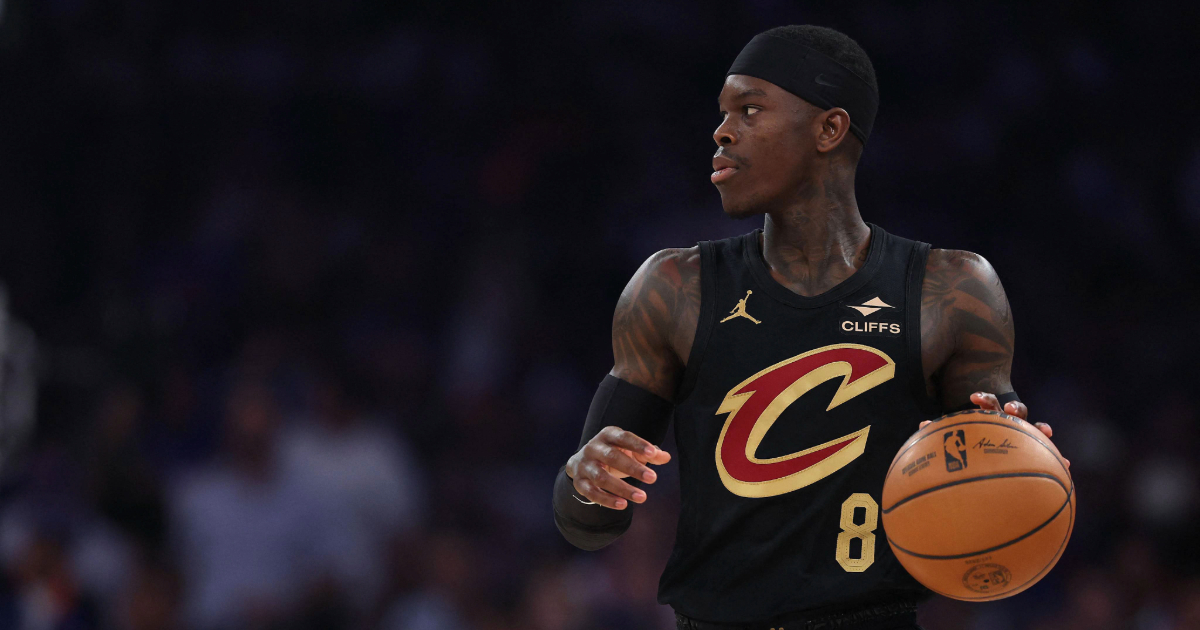



Dennis Schroder is on the move yet again.
The Charlotte Hornets acquired the well-traveled point guard from the Cleveland Cavaliers in a trade for Tre Mann, a move that clears cap space for Cleveland while giving Charlotte a veteran guard to help guide their young core.
Once Schroder puts on a Hornets jersey, Charlotte will become the 12th team of his 13-year NBA career, tying him for the second-most franchises played for in league history. Only another journeyman point guard, Ish Smith, who suited up for 13 teams, has more. Schroder has also been traded nine times in his career, trailing only Trevor Ariza’s 11.
The jerseys in his collection have piled up quickly in recent years. He started last season with the Sacramento Kings before being dealt to Cleveland in February, and now, just half a year later, he’s heading to the Hornets. This movement has become quite routine for Schroder. In 2024-25 alone, he played for three different teams, the Brooklyn Nets, Golden State Warriors, and Detroit Pistons, highlighted by his 23-game run with the Nets where he averaged 18.4 points and 6.6 assists.
Schroder was not always a journeyman though. A native of Germany, he was the 17th overall pick in the 2013 NBA Draft by the Atlanta Hawks, and he spent his first five seasons there. He even picked up Sixth Man of the Year votes in his second and third year in the league coming off Atlanta’s bench, then developed into a full-time starter. His final year with the Hawks was his best full campaign in the NBA: 19.4 points, 3.1 rebounds, and 6.2 assists a game across 67 starts.
His time in Atlanta came to an end when they traded him to Oklahoma City after landing Trae Young in a draft-day deal in 2018. He played in Oklahoma City for two years before kicking off his journeyman era. He hasn’t spent more than a single season with any team since.
The reasons he keeps moving are actually the same ones that keep him employed.
Schroder is entering the second year of a three-year, $44.4 million contract, a very tradeable deal for a player who is good enough to help a rotation as a stopgap option. At 6-foot-1, he’s undersized for a point guard, and his career three-point shooting sits at a modest 34.1 percent. Still, what keeps him rosterable is his ability to run an offense and score in bunches from time to time, along with being a veteran presence that holds teammates accountable–exactly the kind of voice rebuilding or retooling locker rooms need.
It’s a rare combination: He is productive enough to make the rotation, affordable enough to move, and experienced enough that almost any front office can trust him to walk in and help right away.
Across 912 career games, the 32-year-old is averaging 13.7 points, 2.9 rebounds, and 4.9 assists. Those numbers may not scream star power, but they’ve been enough to keep him in demand across more NBA addresses than almost anyone else who has ever played the game. Charlotte is only the latest stop, and if history is any indication, it probably won’t be the last.