


Call it luck.
Call it magic.
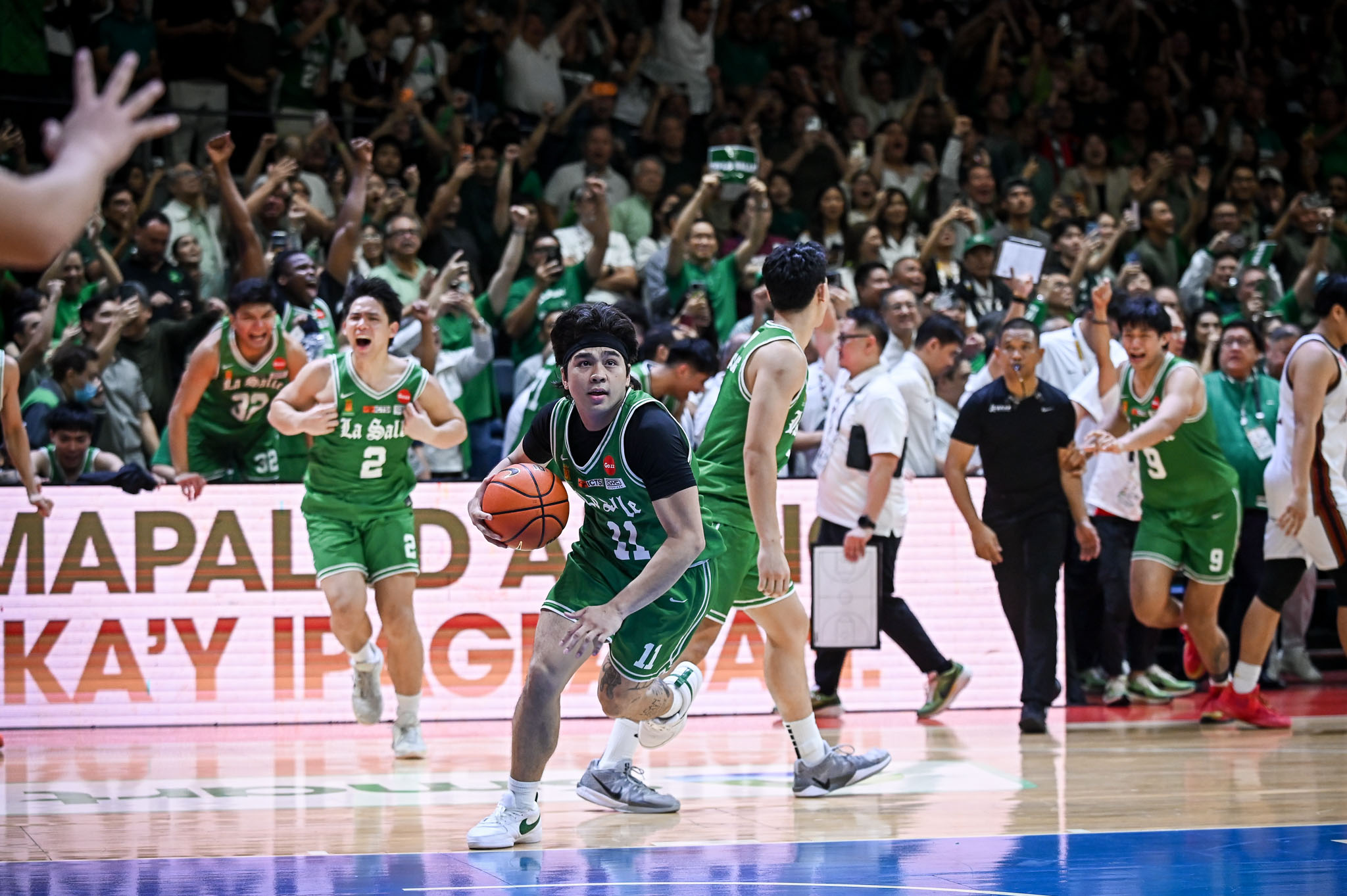
Call it whatever you want to, but as far as the DLSU Green Archers are concerned, it was enough to win the UAAP Season 88 championship.
La Salle weathered everything—a lackadaisical start, injuries and suspensions to key players, and even a late-season slump. Instead of folding, the Green Archers dug deep and emerged as a team worthy of the title.
While the inside-out duo of Mike Philips and Jacob Cortez deservedly drew most of the attention on and off the court, La Salle’s conquest was, at its core, a team effort forged by adversity. These moments could have either been character-building or downright implosive, and head coach Topex Robinson masterfully steered this group towards the former.
Early knee injuries to veteran additions Mason Amos and Kean Baclaan in consecutive first-round games should have derailed DLSU’s campaign. La Salle responded instead with a four-game winning streak—beginning with the very game Baclaan went down—that lifted the Green Archers as high as second place in the standings by the end of October.
It was during this stretch that reserves Luis Pablo and Doy Dungo found their groove while filling in for their sidelined teammates.
With Amos out, Pablo blossomed into one of Robinson’s most trusted players. His breakout came in poetic fashion: a gutsy 14-point effort in a three-point win to close the first round against his former school—and La Salle’s eventual Finals opponent—the defending champion UP Fighting Maroons.
The 21-year-old La Salle Greenhills alumnus thrived as his minutes increased. His intangibles–heady play, consistent effort, and impeccable timing–translated into a tangible impact on both ends of the floor.
Dungo, meanwhile, was thrust into unfamiliar territory. Filling in for Baclaan, the 6-foot-3 wing slid down to point guard, a role he had yet to play meaningful minutes in at the UAAP Seniors level. Slowly but surely, he settled in, becoming a steady contributor for the second unit and a reliable option Robinson could lean on.
The payoff came in the most crucial parts of the season. Both played key roles in La Salle’s championship run, particularly in Game 1 of the Finals against UP. Pablo finished with seven points and six rebounds, but his most significant impact came on the defensive end—two steals and three blocks, most of which came late in the fourth quarter to help fend off the Fighting Maroons’ late push.
Dungo, meanwhile, provided an early spark, pouring in 15 points in just 15 minutes to help La Salle keep pace with the hot-shooting UP. Robinson had kept the sophomore on the bench in La Salle’s previous outing—the second of two Final Four wins over NU—but EJ Gollena’s two quick fouls opened the door for Dungo to check into Game 1. He rewarded that trust immediately, drilling a three-pointer on his first offensive possession that set the tone for a blistering performance.
DLSU took Game 1 of the Finals, 74-70, and it would not have been possible without the contributions of Pablo and Dungo.
Looking back, the road to the Finals, however, was anything but smooth.
After the October surge, La Salle slipped into an early-November slump that tested its resolve. The Green Archers dropped three straight games, with each defeat uglier than the previous one. Their championship ambition was tempered by their eight-point loss to the first place Bulldogs in early November, then their chances were almost completely shattered altogether by back-to-back one-point losses to the Adamson Soaring Falcons and FEU Tamaraws–two teams hovering outside the Final Four picture.
At 6–6, La Salle found itself in precarious territory. Not only were their title hopes fading, but even a Final Four berth was far from assured at that point. La Salle’s last two elimination round foes were no pushovers either–their familiar foe UP and longtime archrival ADMU Blue Eagles with whom they were in a tight race for the fourth seed.
Many previous iterations of the Green Archers under different regimes crumbled under similar pressure (See: UAAP Seasons 72, 74, 81, 82, 85). This group responded differently. The Green Archers regrouped with composure, aided by the timely return of Amos ahead of their second round showdown with UP.
The Green Archers defeated UP for a second time, completing a two-game sweep of their elimination-round series. Their form carried into the season finale three days later against Ateneo. La Salle avenged its first-round loss with a six-point victory over ADMU that, in one blow, secured their Final Four berth and also eliminated their archrivals for the season.
DLSU squeezed into the Final Four by the skin of their teeth, only to be met by another daunting challenge—a matchup with the Bulldogs, who carried the customary twice-to-beat advantage and also stood as the lone team that the Green Archers had yet to defeat in Season 88.
None of this daunted La Salle.
Baclaan returned to face his former team, and La Salle charged out of the gates, building a 13-point first-quarter lead. The Green Archers controlled the contest, securing a 10-point win that forced a winner-take-all rematch.
The second meeting proved tougher. Trailing by six at halftime, Cortez erupted for 19 of his 29 points in the second half, lifting La Salle to a five-point victory and a third consecutive UAAP Finals appearance.
With their backs against the wall time and again, the Green Archers survived by leaning into their killer instinct.
A key storyline during these trying weeks leading up to the finals was that second-year guard Vhoris Marasigan emerged as one of La Salle’s top scoring options. After being ejected from DLSU’s second round loss to NU, he was suspended for their next game against FEU as punishment for this infraction.
Marasigan returned for the Green Archers’ matchup against Adamson looking like a different player altogether, channeling the same aggression that led to his ejection against the Bulldogs into a relentless attacking mindset. His downhill drives became a constant pressure point that bent opposing defenses to his will.
Over his first five games back from his suspension, Marasigan averaged 12.8 points–scoring in double figures each time. That stretch began with the loss to the Soaring Falcons, continued through the pivotal elimination-round wins over the Fighting Maroons and Blue Eagles, and culminated in a stunning two-game upset of the Bulldogs in the Final Four.
The 6-foot-2 guard established himself as the secondary perimeter scorer La Salle badly needed to relieve pressure from Cortez. The role earned him a permanent place in Robinson’s closing lineups—and trust in the season’s most delicate moments.
That trust placed Marasigan on the floor opposite Cortez in the dying seconds of Game 2 against UP where La Salle trailed by two points with the ball in their possession. Cortez drew a double team that forced him to swing the ball to Marasigan, who had a match-up against Harold Alarcon. Marasigan sized him up and rose for a pull-up three that rattled in and out—a miss that was less than half an inch from delivering not just the game, but the championship itself to DLSU.
UP escaped with a three-point win, forcing a winner-take-all Game 3 between the same two teams for the third straight season.
That miss could have lingered as the defining moment of Marasigan’s career–in Filipino terms, a multo. Instead, it became a turning point—proof of his and this team’s mental toughness. Marasigan never wavered in Game 3, playing with the same conviction as if the miss had never happened.
Late in the contest, the Fighting Maroons seized momentum when Rey Remogat buried a three to go up 67–64. It felt as if a second straight title was within reach for UP—until La Salle pushed back. Amos hit two free throws to cut the lead down to a point. Then, between the 3:05 and 2:17 mark of the fourth quarter, Marasigan seized control of the game in the Green Archers’ favor. He scored five straight points to flip a one-point deficit into a four-point, 71–67, advantage.
Fittingly, the first two points of that run came on a pull-up jumper that similarly teased the rim—rolling out, popping straight up, kissing the backboard, and grazing the front of the basket before finally dropping through the net. Whether it was redemption, vindication, reclamation, atonement, or even exoneration, simply put, it was Marasigan’s defining moment.
When the final buzzer sounded to signal the end of Game 3, Marasigan’s influence over their win was undeniable. He earned his place as a beloved icon for DLSU—with their crowd chanting his name in unison following the win—as they would not have won the championship without his defining fourth quarter heroics.
Sure, Philips and Cortez put up the gaudy numbers all season long—and with this title, cemented their places in the program’s pantheon of legends—but none of it would have been possible without the “other” guys doing the little things for La Salle.
Pablo, Dungo, and Marasigan exceeded expectations. Veterans Gollena, Earl Abadam, and JC Macalalag filled their roles to near perfection. The rookies—Lebron Daep, Guillian Quines, Rhyle Melencio, and Gian Gomez—had their moments too, offering glimpses of what lies ahead.
Amos and Baclaan, too, became vital pieces—though not in the way many envisioned. Their early absences created a vacuum that forced their teammates to grow into larger responsibilities. When they returned, they embraced reduced roles without hesitation despite having been stars on their former teams.
A championship run is fueled by sacrifice, and these two made among the biggest ones for DLSU. They wound up having their share of moments too, including knocking down crucial free throws along the road to the title—an invaluable contribution for a La Salle team that has struggled at the line for years.
None of this happens without Robinson’s influence. He has brought stability to an unstable program that has not had a constant identity following multi-titled former head coach Franz Pumaren’s departure in 2009.
In the 12 UAAP seasons between the end of the Pumaren era and the arrival of Robinson, La Salle had seven different head coaches who achieved varying levels of success. The positive culture that Robinson has brought in over his first three years has done wonders for the Green Archers and the results do not lie. Moving forward, it should only help the team continue attracting the best prospects in the years to come.
La Salle’s UAAP Season 88 title run cannot be characterized by a single person, a single play, or even a single game. They had their backs against the wall for practically a month and the championship win was the culmination of countless bouts of adversity that they conquered. Different players stepped into unfamiliar roles, embraced the greater good, and delivered when needed in the biggest of moments.
The Green Archers stumbled and were tested repeatedly, yet never broke. Their collective belief and resilience turned them into the best versions of themselves. When it was all said and done, they stood tall as the UAAP champions.
Don’t call it luck.
Don’t call it magic.
Call it what it is: the Animo Spirit.